
What Makes a Proper Place For Domestic Helpers To Rest? | Singapore | Best Home

Updated: 1 hour ago

Editorial Disclaimer:
The views and observations expressed in this article are based on Best Home Employment Agency Pte Ltd’s experience serving Singapore employers and domestic helpers for approximately 30 years, since 1996. They represent our professional observations and opinions and should not be taken as statements of fact, legal advice, or official positions of the Ministry of Manpower (MOM) or any other government authority. Where this article refers to laws, regulations or MOM requirements, readers should refer to the relevant official government sources for the applicable and latest requirements. Individual household circumstances may differ, and employers should seek clarification from the relevant authorities where necessary.
What Makes a Proper Place For Domestic Helpers To Rest? Is a Bomb Shelter Okay? Is a Laundry Room Okay?
The question of where a domestic helper should sleep is rarely straightforward in Singapore.
For some households, there is a helper's bedroom. For others, there is a household shelter, a study room that doubles as a home office, or simply a corner of the living room. In smaller flats, finding space for another person can be a genuine challenge.
But perhaps the more important question is not simply where a domestic helper can sleep.
It is whether she can actually rest there.
That question has come into sharper focus in Singapore in recent weeks following a widely discussed social media post showing a domestic helper's sleeping area in a four-room BTO flat. The original post showed a single bed in a room that also contained a home-office setup, separated by a divider. The post attracted significant online criticism before the homeowner clarified that the room was used as an office during the day and that the helper had the entire room to herself at night. Mothership reported on the original post and subsequent clarification. (Mothership)
The discussion has since broadened into a larger conversation about the realities of employing live-in domestic helpers in Singapore. CNA's commentary on 16 September 2026 similarly examined the tension between limited living space and the need to provide a domestic helper with appropriate accommodation. (CNA)
For an industry that has been discussing this issue for many years, the recent attention is a useful opportunity to revisit what employers should know.
At Best Home Employment Agency, we have been serving thousands of families in Singapore since 1996. Over the last 3 decades, we have witnessed homes of every size and countless different household arrangements.
We understand that not every family has the luxury of an available bedroom. That being said, we also believe that space constraints should not mean that a helper's need for proper rest and privacy is overlooked.
What Does MOM Require for Domestic Helper Accommodation?

Singapore's Ministry of Manpower (MOM) has established accommodation requirements for migrant domestic workers (MDWs) as part of the employer's responsibilities.
MOM's official guidance on rest days, health and well-being for MDWs states that employers should provide a separate room where possible. Where this is not possible, the employer must ensure that the accommodation provides adequate space and privacy. (Ministry of Manpower Singapore)
MOM also requires the accommodation to be safe and sufficiently ventilated, provide shelter from the sun, rain and strong winds, and not compromise the MDW's privacy or modesty. Basic amenities must also be provided.
In practical terms, employers should pay attention to these several key areas:
Adequate Shelter and Ventilation
A domestic helper's sleeping area should be properly sheltered and have sufficient ventilation.
This is particularly relevant in Singapore, where enclosed spaces can become hot and humid.
MOM specifically states that mechanical ventilation should be provided if natural ventilation is inadequate. A fan can therefore be an important part of an appropriate sleeping arrangement, but employers should consider the overall environment rather than assuming that putting a fan into an enclosed space automatically solves the problem.
Basic Amenities must be provided
Employers must provide basic sleeping amenities, including a mattress, pillow and blanket. Employers must also minimally provide with a simple set of toiletries. Examples of toiletries include soap, shampoo, toothbrush, toothpaste, etc.
Beyond these minimum requirements, a proper bed, suitable lighting and adequate storage can make a significant difference to the usability of the space.
A domestic helper should have somewhere to keep her clothes and personal belongings rather than having to store everything in boxes or shared household cupboards.
Safety
The accommodation should be safe and free from obvious hazards.
This is particularly important when employers consider using a storeroom or household shelter as a sleeping area.
A room filled with boxes, cleaning equipment or miscellaneous household items may technically have enough floor space for a mattress, but that does not necessarily make it a safe sleeping environment. In addition, it is generally not a good idea not to designate a helper's rest area near potential electrical or fire hazards.
Privacy and Modesty
Privacy is an important part of MOM's accommodation requirements.
MOM states that an MDW must not sleep in the same room as a male adult or teenager. Employers should also ensure that the accommodation does not compromise the helper's modesty.
The same principle applies to surveillance. If video-recording devices are installed in the home, employers must inform their MDW about them and where they are located. Such devices should not be installed in areas that compromise privacy or modesty, such as bathrooms and sleeping areas.
Employers can refer to MOM's guidance on employing an MDW for the current accommodation requirements. (Ministry of Manpower Singapore)
Does Every Domestic Helper Need Her Own Room?

This is one of the most common questions employers ask.
The answer is not simply yes or no.
MOM encourages employers to provide a separate room. However, it recognises that some Singapore households have genuine space constraints. Where a separate room is not possible, the employer must still provide adequate space and privacy.
MOM's guidance also specifically recognises the situation faced by families living in smaller flats. For example, MOM's FAQ on families living in two-room HDB flats explains that the Ministry will consider the family's circumstances while emphasising the employer's responsibility to provide adequate privacy and sleeping space. (Ministry of Manpower Singapore)
This is an important distinction.
The objective should not be to find the smallest possible space that can accommodate a bed. It should be to create a sleeping environment that is safe, private and genuinely conducive to rest.
When Space Is Limited: Making a Common Area Work

For some families, a properly arranged section of the living room may seem to be the most realistic option.
A common-space arrangement should provide a proper sleeping surface and meaningful privacy. A substantial partition, screen or curtain may help separate the sleeping area from the rest of the household. There should also be somewhere for the helper to keep her clothes and personal possessions.
But location matters.
A bed placed near the television or living room sofa may mean that the helper is regularly disturbed at night. A sleeping area beside the dining table may expose her to household activity late into the evening. Placing her next to the main entrance can mean constant foot traffic, while positioning her beside a common prayer area or pet's sleeping area may create its own problems.
Even the most carefully installed partition cannot compensate for a fundamentally unsuitable location.
A sleeping area should also not be treated as an afterthought simply because it happens to occupy part of a common room. It should feel like a defined personal space.
Should a Helper Sleep in a Storeroom, Laundry room or Bomb Shelter?
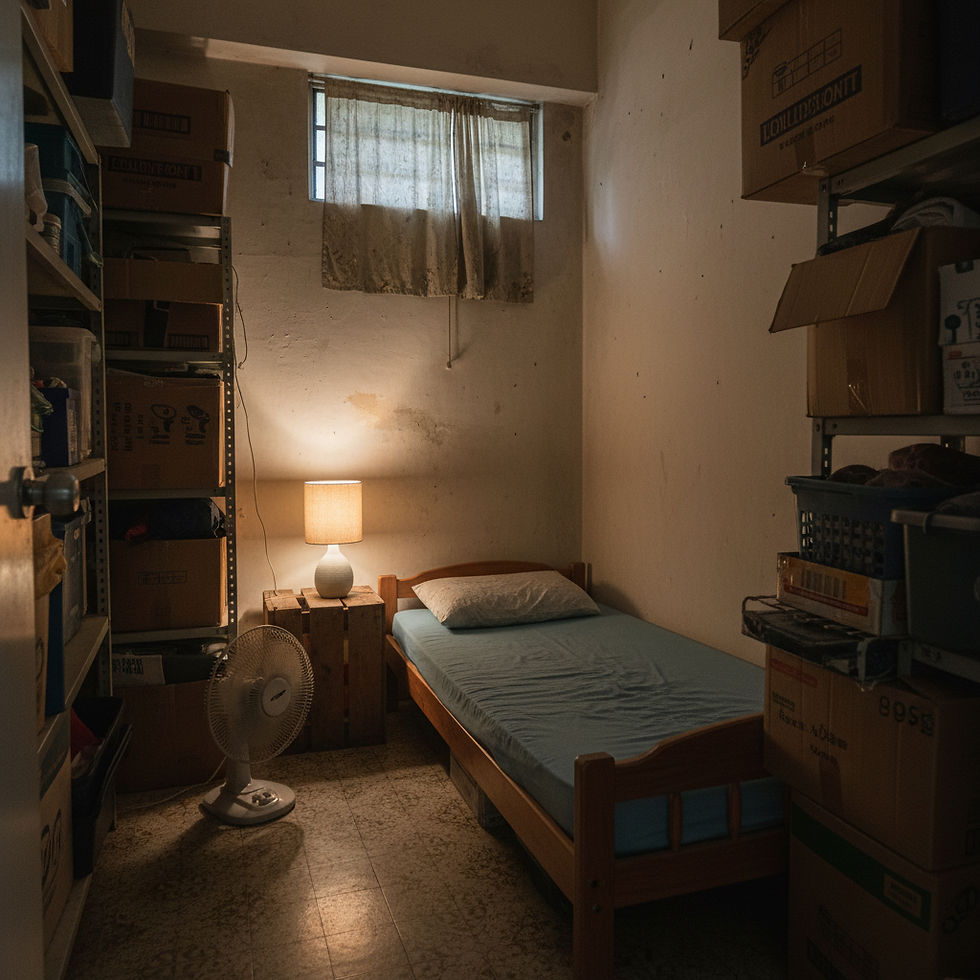
This is perhaps one of the more difficult questions for employers living in smaller HDB flats and condominiums.
The subject is not new. In 2024, Singapore media outlet RICE Media examined the growing practice of marketing household shelters and utility rooms as "maid rooms", raising questions about the practical realities of such arrangements. (YouTube)
More recently, Singapore online discussions have again focused on bomb shelters and utility rooms. In June 2026, one Singaporean sought advice online after her family considered moving their domestic helper from a proper bedroom into a household shelter following a change in their living arrangements. The Independent Singapore reported on the discussion. (The Independent Singapore)
The issue is understandable. In a compact home, the household shelter may appear to be the obvious unused room.
But employers should be careful about treating it as an automatic solution.
A conventional household shelter or storeroom can feel enclosed, especially when the heavy door is closed. It can also become hot or stuffy if ventilation is inadequate. If the room is simultaneously being used to store boxes and miscellaneous belongings, the environment can become even less suitable.
Simply putting a fan and a lamp inside does not necessarily make the space comfortable.
That said, in recent years, we have also seen families make considerable effort to improve such spaces. A household shelter or former storeroom can be kept clean and uncluttered, furnished with a proper bed, provided with suitable ventilation and lighting, and organised so that the helper has meaningful personal space.
The distinction is important: is the room actually being prepared as a place for a person to live and sleep, or is a storage room merely having a bed placed inside it?
Employers should also seek advice from the relevant authorities and qualified professionals before undertaking renovation or structural alterations. As a maid agency, Best Home is not a renovation contractor or building consultant, and we would not advise employers to make structural changes based solely on our advice.
What If a Helper Shares a Room?

Some families may have no alternative but to consider a shared bedroom.
Where a proposed sleeping arrangement involves room-sharing, employers should check the latest MOM requirements and obtain any required approval before proceeding.
MOM's rules regarding privacy and who an MDW may share a room with are particularly important. Employers should never assume that an arrangement is acceptable simply because the family and helper have verbally agreed to it.
Even where room-sharing is permitted, the household should establish reasonable boundaries around sleeping hours.
This can be especially important when young children share a room with the helper.
Children may naturally wake during the night, but employers should distinguish between genuine caregiving needs and non-urgent requests. If the helper is expected to wake repeatedly for routine matters, her opportunity for meaningful rest can be affected.
A clear household routine can help everyone understand when the helper is working and when she is resting.
Why Rest Matters for Domestic Helpers

Domestic helpers are sometimes viewed primarily through the lens of housekeeping.
But the role has changed considerably over the years.
Many Singapore families employ a domestic helper because they require assistance with childcare or eldercare. A helper may spend part of her day preparing meals and cleaning the home and another part bathing an elderly family member, assisting someone with mobility difficulties, preparing medication reminders or caring for young children.
These responsibilities can be physically demanding.
The need for proper rest is therefore not an abstract welfare issue. It is part of creating sustainable working conditions.
A person who has spent the day caring for children or an elderly family member needs somewhere to return to at the end of the day where she can sleep without unnecessary noise, disruption or lack of privacy.
This is true for everyone.
What We Have Observed as a Maid Agency Since 1996

At Best Home, we have worked with Singapore employers and domestic helpers for three decades.
One of the observations we have made over the years is that accommodation can form an important part of the overall employer-helper relationship.
Helpers who are provided with accommodation that meets MOM's requirements-and where possible goes beyond the basic minimum-often have a better environment in which to settle into a new household.
We have also observed cases where helpers remain with families for many years when the overall employment relationship is positive and their living arrangements are properly considered.
Of course, accommodation alone does not determine whether an employment relationship succeeds. Salary, workload, rest days, communication, personality, caregiving responsibilities and mutual expectations all matter.
But accommodation is one factor that an employer can address from the very beginning.
Providing a proper place to rest is not a guarantee of long-term retention. It is, however, a practical expression of consideration for the person who will be living and working in the household.
A Simple Test for Employers

There is a surprisingly straightforward way to assess a proposed sleeping arrangement.
Imagine that you are the person who will sleep there:
Would you be comfortable closing your eyes at night?
Would the room be too hot?
Would you hear the television?
Would people walk past your bed?
Would you have somewhere private to change?
Would your belongings be safe?
Would you be able to relax completely?
Would you feel comfortable inviting a friend or family member to see where you sleep?
Would you wake up refreshed enough to begin another full day of work?
The answers can be revealing.
An employer does not need to provide a luxurious bedroom.
But there is a difference between a small room and an unsuitable room.
There is also a difference between making the best use of limited space and simply allocating whatever space is left over.
The Human Side of Employing a Domestic Helper
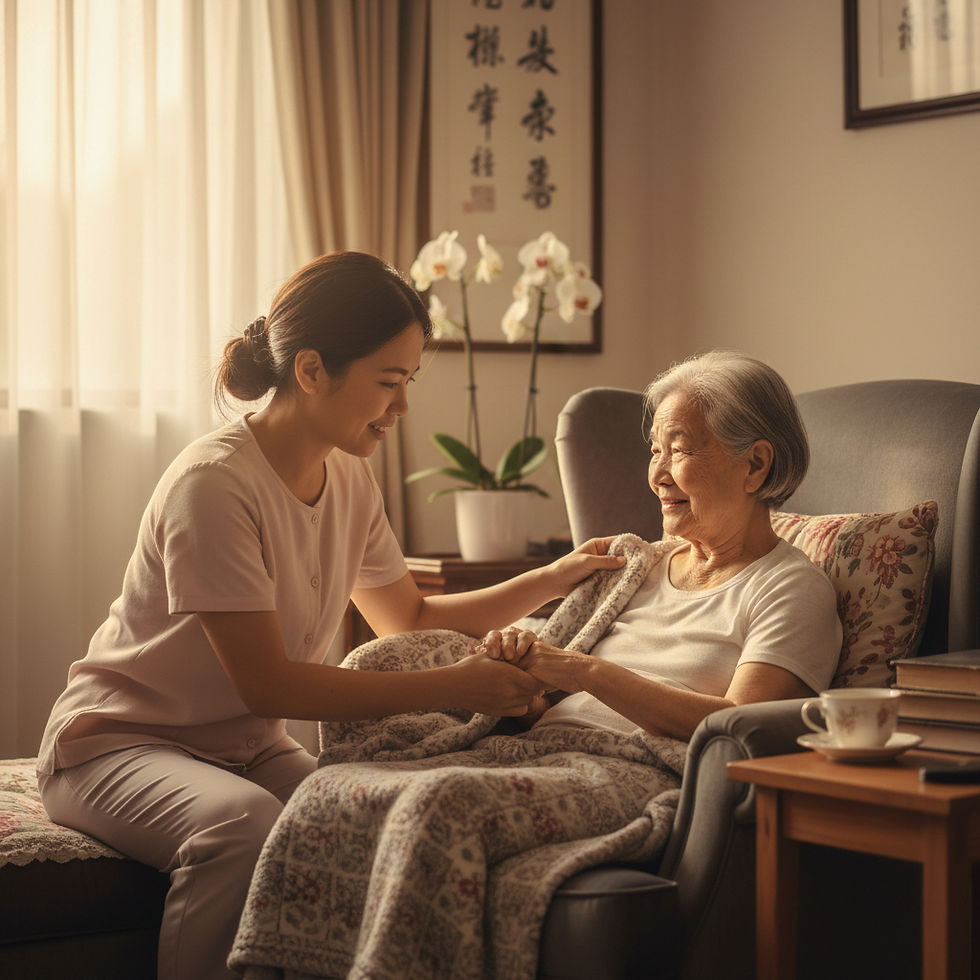
At its heart, the accommodation discussion is about something quite ordinary: rest.
Singapore is a fast-paced city. Most of us know what it feels like to come home after a long day and simply want a quiet place to rest.
A domestic helper is no different.
For many employers, hiring a maid is critical to the well-being of their own family. The helper may allow parents to balance work and childcare, enable elderly family members to remain at home, or simply make a challenging household situation more manageable.
But the arrangement also brings another person into the home.
That person needs a place to sleep, change, keep her belongings and have personal space.
Where an employer has an available room, providing it is often the simplest solution. Where there is no spare room, thoughtful planning can still produce a workable arrangement.
The goal is not perfection.
It is consideration.
And perhaps the most useful question remains the simplest one:
"If this were your sleeping area, would you be able to rest comfortably here?"
Consider Your Helper's Rest Area Compassionately
For families considering a domestic helper in Singapore, the right place to begin is not simply with the question, "Which maid should we hire?"
It is also worth asking:
What kind of household can we provide for the person who will be living and working with us?
A good employment relationship begins with both sides understanding their responsibilities.
And sometimes, that begins with something as basic as giving someone a proper place to rest.
Choosing the Right Maid for Your Household

A suitable living arrangement is only one part of a successful employer-helper relationship.
At Best Home Employment Agency, we have been serving Singapore families since 1996, with experience in full-time maid placement, recruitment, training, matching and post-handover support.
We also provide part-time maid services under the Household Services Scheme (HSS) for households that may not require a live-in domestic helper.
Whether your family needs assistance with housekeeping, childcare, eldercare or a combination of responsibilities, our team can help you assess your household's requirements and understand the options available.
Best Home is also proud to be recognised as a Singapore SME500 Winner.
If you are looking for the BEST full-time helper or part-time cleaning services, reach out to our live agents now!


Comments